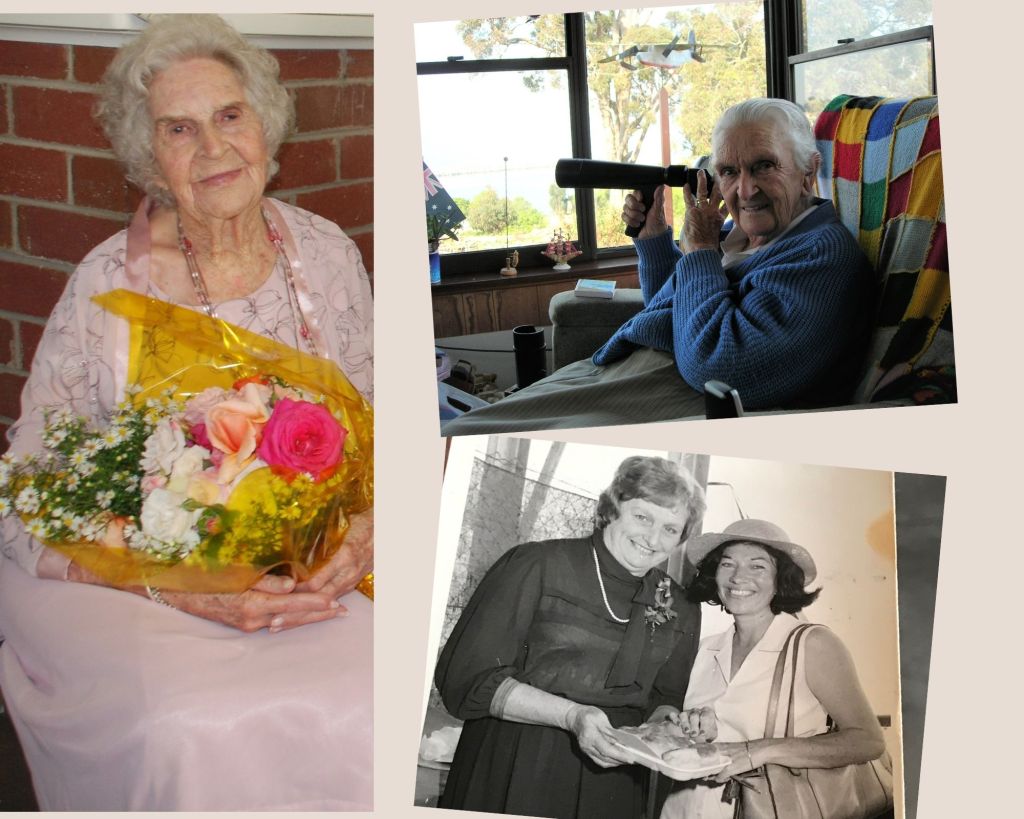
It’s 1933 in the NSW Snowy Mountains’ town of Berridale, and a young, newly-married woman submits a report of a cricket match to her local paper. Noticing her way with words, the editor of the Cooma Monaro Express asks her to try her hand at wedding reports, social events and obituaries. Seventy-six years later, Lily Constance would still be writing the Berridale News, documenting the most joyful, and the most tragic, events of the lives of her friends and neighbours.
In 1930s Eden on the far south coast of NSW, a young girl who prefers playing on the town’s wharf to going to school is given a ledger book by her father for her 16th birthday. For the rest of her long life, Jean Whiter will record the maritime details and the social life of the port town in her column Tugboat Annie for the Eden Magnet.
In the 1980s in the outback town of Katherine, a bright and sociable young mother writes a weekly column called Around the Town, bubbling with social news. Nola Sweetman understands the power of her column to reach out to people living in her remote community, telling me “it’s always the little things that matter”. This is shoe-leather journalism at its best; if she’s short on leads for her column in The Katherine Times, she drops into the local florist, enquiring as to who had bought flowers that week, and why.
These writers are part of an enormous unpaid workforce of women, whose millions of column centimetres have created a lasting social history of rural Australia. Delivered faithfully each week, often to gruff male editors, their words are intimate, colourful and deliciously diplomatic. Any one column may contain a cure for blue bottle stings and a fruit cake recipe alongside details of someone’s recovery from an operation, and it is true it’s the “little things” that build the story for us; the lemon chiffon of a bridesmaid’s dress, the intricate embroidery on a tablecloth, the blue eyes of a new born baby.
Often referred to as “women’s news,” these columns were branded by some as “gossip”, in an attempt to diminish what is considered to be the largely feminin1e preoccupation with social connection. In the language of media, this type of news has earned the derisive label of “parish pump”. But to read these columns was as comforting as a weekly chat over the fence with a friend, and those important looking editors knew their newspapers couldn’t do without it.
Nola Sweetman arrived in Katherine as a city girl who had come to the outback for love. These were the wild old days when the Northern Territory’s flying doctor, Clyde Fenton, would land his plane in the main street and go into the pub for a beer. Through her reporting Nola met Mother Teresa when she visited the Territory and quizzed Flo Bjelke Petersen about her pumpkin scone recipe. But her bread and butter was the social life of Katherine and its outlying communities and cattle stations. Editor Vince Fardone told Nola how he liked to stand in the newsagent and watch people pick up the paper and turn straight to her page.
“I found I could write so easily,” Nola told me. “I wrote a lot of letters home to mum and I always kept a diary, just writing the way I talk. Anything that amused me, I’d write about that. I’d type it up and take it in. I used to sit in there while someone type-set it, then I’d proof read the whole lot. I slept with a notepad by the side of the bed in case I thought of something during the night.”
On the far south coast of NSW, the town of Eden is alive with stories of killer whales and swashbuckling pioneers. Jean Whiter’s column, Tugboat Annie, reads like the town’s very own “shipping news” and has taken its place in the history of the district.
As a young girl, Jean got to know all the fishermen and developed her lifelong interest for the life of the sea. Her daughter Jenny told me that writing the column was a big part of Jean’s life and that Tugboat Annie was much loved by readers.
“If any boat would poke its nose round the corner Mum was on to it. She also usually had a little bit of a ramble about what had happened, some social news. She had little hard-cover diaries, where she would list all the boats. She would keep a watch out for who came and went. She noted the whales coming in, the chip ships (for the nearby chipmill), and anything unusual. We’ve had oil rigs moored in the middle of the bay, naval ships and submarines. During a bumper tuna season years ago half the Port Lincoln fleet was here.”
Jenny told me that for many years her mother wrote her column by hand and took it up to the office of the Eden Magnet.
“Then we got her a typewriter. She would type it and fax it, then finally she got a laptop and typed it and emailed it. The Magnet editor would either receive no copy or many copies until we showed Mum how to check the ‘sent items’ box,” Jenny said.
Jean’s favourite time of year was the Sydney to Hobart Yacht Race, and she would be standing by to note which crippled yachts were making their way into Twofold bay. Many tired and cold sailors received a hot shower, tea and scones at Jean’s home. Jean’s entries track the fortunes of the forestry and tuna-fishing industries on the far south coast and the rise of tourism. Her column also noted the seasonal arrival of whales in Twofold Bay, echoes of the town’s incredible whaling history and legendary relationship with the killer whales. Whale watching is now a major industry in Eden and a loud siren still sounds across the town when a whale is spotted in the bay.
In her later years, Jean, who was known to everyone in Eden, delivered her column by motorised scooter.
Lily Constance was from pioneering stock in the Snowy Mountains, and her love of writing has a curious connection. Lily was a descendant of the convict William Blyton and her family can be traced back to the beloved British children’s writer Enid Blyton. I spoke to her a couple of years before her death at the age of 100 and she told me how she took particular pride in accuracy.
“Writing was no trouble. I was always the best speller at school although I say it myself. I often wrote at night. The editors would say, ‘you are one of the few who can spell’. I never had a contradiction or made a mistake or had a complaint in all those years. They never, ever rang up and said ‘you didn’t say that nicely’. I liked writing and would still do it if my eyes weren’t failing.”
Photographs were rarely used in early newspapers, so descriptions of dresses, hair pieces and flowers needed to paint a picture for the reader. In the days before press release journalism, affection and pride in community shines through every word in columns like The Berridale News. There is a generosity in these reports. For any given event, such as a ball, every person who contributed in any way is acknowledged, praised and warmly thanked.
“I wrote with a pencil at first, then with a pen and ink, biros weren’t in then. Mr Craigie gave me a fountain pen and I thought I was made – I’ve still got it… it still works.”
Lily, who wrote for the best part of a century, was typical of many of these social correspondents, who saw many editors and reporters come and go. She told me that in the early days her work was treasured by editors, but this attitude changed in the 1990s.
“Sometimes I’d get cross, after Mr Craigie (editor, Wallace Craigie) left. Sometimes you’d send it in and they’d leave it on the desk and put other things in they thought were more important, and they’d leave it.”
Accuracy is one thing, but for the social correspondent, a particular kind of delicacy is also required.
“Sometimes when the bride was pregnant they didn’t want (the wedding report) in the paper,” she told me. “You guessed when you asked them, they would just say quietly, ‘oh no I don’t think I’ll bother’. But the birth would go in, and because the wedding hadn’t been in the paper people wouldn’t remember when the wedding was.” Lily was also sensitive when writing obituaries.
“They would come to the house and they would sit there and I’d write and they’d tell me about the life of the one that had died. Now, I’d lost my own mother when I was eight, I knew what death meant. I had learned to take death at a very young age.”
When bereaved relatives came to see her she would have her best lace tablecloth out, a pot of tea and a tin of homemade biscuits waiting for them.
“It wasn’t happy news, but they were happy to have it in. It was just these pregnant brides I had to steer clear of.”
Lily wasn’t paid regularly, but does remember on one occasion being given a cheque for “100 pounds”. This was probably in Cooma’s boom time, during the construction of the Snowy Hydro Scheme when the newspaper would have been doing very well.
In Katherine, About Town was also a labour of love for Nola Sweetman.
“I didn’t get paid, but every time I’d threaten to leave Vince would give me a box of chocolates and some flowers,” she said.
Nola eventually turned her experience in writing wedding reports to a more profitable venture, becoming a marriage celebrant herself. She is still practising in Katherine today.
When Jean Whiter passed away, Tugboat Annie was no more.
“People really did enjoy reading it. People loved it,” her daughter Jenny said. “There was general disappointment when the column stopped. She always started every column off with ‘Permission to come aboard?’”
Lily Constance must be one of the country’s longest serving correspondents. When her eyesight began to fail, her daughter Judy Costello took over, and went on to write “Judy’s Jottings”. Judy continued to write until the closure of the Cooma Monaro Express in 2016. Together, mother and daughter filed social news of the district for 93 years.
Today, it’s hard to fully appreciate the revered status once held by the local newspaper in the life of country Australia. Many of the charming and quirky conventions of days gone by have already been consigned to history. While some social columns can still be found in country newspapers, they have mostly disappeared over time. Contributors have grown old and died, with no one willing or able to take their place. With the downturn in print circulation, paging has shrunk, and space has become precious to editors. Social and community news, and other contributed news, have been a casualty of this and have not necessarily carried over onto newspaper websites.
The work of these three writers is typical of the contribution of many hundreds of others like them around the country. With an eye for detail and a flair for conversational prose, these social columnists have recorded the small moments and milestones of Australian life for prosperity. In a modern world that depends on facebook, instagram and twitter to achieve a sense of “connection” with our various tribes, writers like Lily, Jean and Nola were ahead of their time. They understood the need for belonging and their stories were born of the natural interest we have in others and in the world around us. This is not just “women’s business.” Their work should rightly take pride of place in the history of community journalism.
 kathysharpe.com.au