Stories live here.
They start off shuttered inside cabins, but make their way out, sitting down at the dinner table, exhaling along verandahs, drifting out into the night garden.
We come here, propelled by our own story and drawn to the stories of others. Words are untangled, in the night over glasses of wine, in the mornings over sunshine and coffee, in the quiet of the golden afternoons.
A very old story lives here, and it whispers around my cabin, in the wind bending the gum trees, in the scattering of rain drops on the roof, underneath the faraway sound of the mopoke’s call. A writer, bent over a desk, in the cold of winter and the heat of summer. A death bed confession, some scattered papers of a manuscript, a secret long held fear.
The first morning I woke to pouring rain. The downpour heralded a fortnight of creative immersion, new friendships and delight in the natural environment of the Perth Hills. The days quickly assumed their own rhythm; writing, thinking, revising, rewriting, walking, talking, reading, day-dreaming.
Often I woke up in the middle of the night full of thoughts and ideas and half remembered dreams. The strange sounds of night birds outside the window suggested some secret life going on while everyone else slept. I don’t know the songs and calls of these West Australian birds that work the night shift, singing all night. I would lie awake and wonder about them.
During those sleepless hours, I read the biography of Katharine Susannah Prichard, stitched together with her own words in letters, diaries and journals. She began to emerge, a stronger outline each day. Out through her pages she came, uncompromising, idealistic, a loving mother, a rigorous intellect. She bent her back to the task of writing, toiling as hard as the workers she championed all her life. Katharine is a reminder that you persevere, fighting your way through rejection and doubt. You give it time. You give it your full attention. You don’t give up.
During the days, I begin to see the garden with her eyes, noticing the colours of the flowers, feeling the heat coming off the hills, hearing the wind sweeping through the garden. All the while, I engage in a strangely joyful wrestle with my own story. We are old sparring partners, my story and I, but I’m determined to get the better of it in the end.
The creamy barked gums outside my window bow towards the bottom of the garden. In a hollow in the branch a family of 28 Parrots duck in and out of their nest. At night, bandicoots scratch about.Builders are working to restore the simple, wooden cabin where Katharine’s words were worried over, corrected, revised, worried over again, doubted, judged, delivered to a journal or a publisher, then doubted again. In that small room lives the joy and despair of writing. Throughout personal tragedy, crushing poverty and political opposition, she never strayed from her values or abandoned her craft.
I wonder how much of writing is really just about the desire to be understood. On the whiteboard, my chapters are laid out in pink and black texta. By the end of each day they are a maze of arrows and squiggles and questions marks and crossings out. The story inhabits the cabin with me, whispering into my sleep. In the daylight hours, the luxury of time creates a magical space. Pressure is gone. Judgement is gone. Playfulness is back. I remember, this is what I do, this is who I am. Time flows over and around and away again. I barely notice.
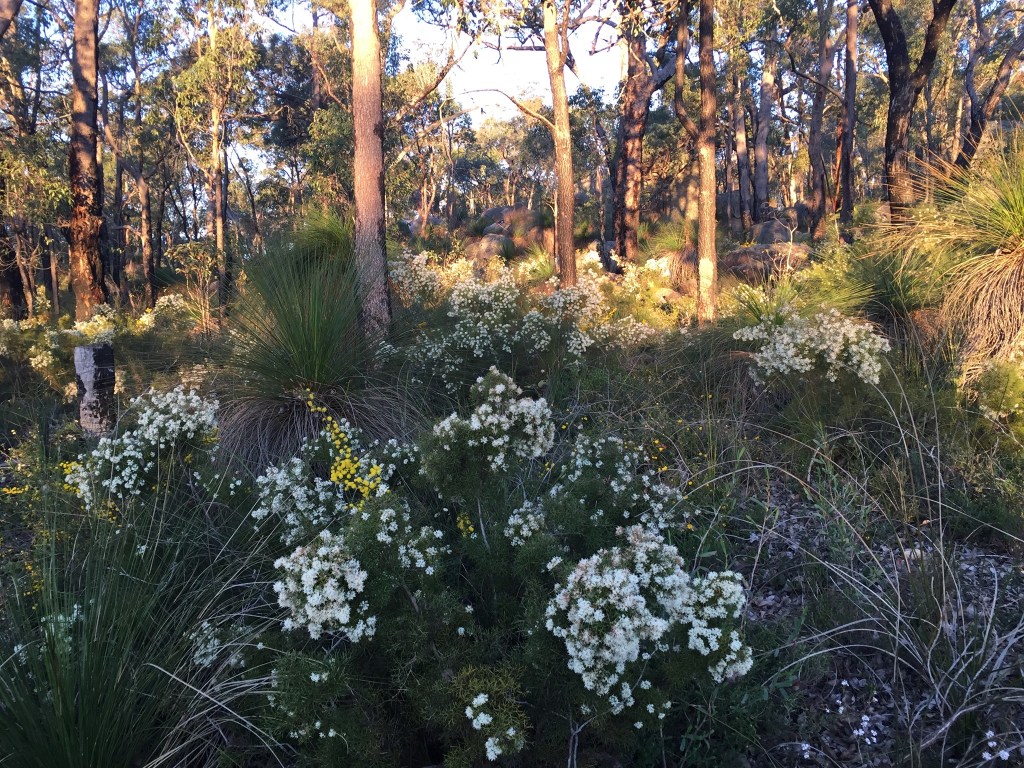
An hour before sunset each day, my cabin neighbours and I go to John Forrest National Park. We walk in the last rose coloured light of the day, looking out over blackboys and wildflowers. The waterfalls are rushing after the torrential rain that had us putting bath towels under the door to stop Katharine’s kitchen from flooding. We see kangaroos daily, and once, an enormous flock of black cockatoos sailing through the sky, too many to count, a great cloud of them, going on and on.
In the evenings we toast our progress with champagne and watch the sun slip down behind the Perth skyline. I update the others on Katharine’s progress from my nightly readings. The plot points of her story are tragedy, struggle, activism, poverty and fierce, protective love. We look at the old photos of her in the house and in her library. In some photos she is a young crusader. She stares out of the frames, beautiful and intimidating. In another, she is an old woman, standing out in the garden sunshine, feeding the birds. I can understand the peace she found here, how this place was a refuge for someone who spent most of her life bucking the system. Katharine, in her hat, looking earthy and eccentric, holding out food for the birds that would have been her constant companions. Katharine; completely at home.
 kathysharpe.com.au